
The Desert Blooms
The Desert Blooms
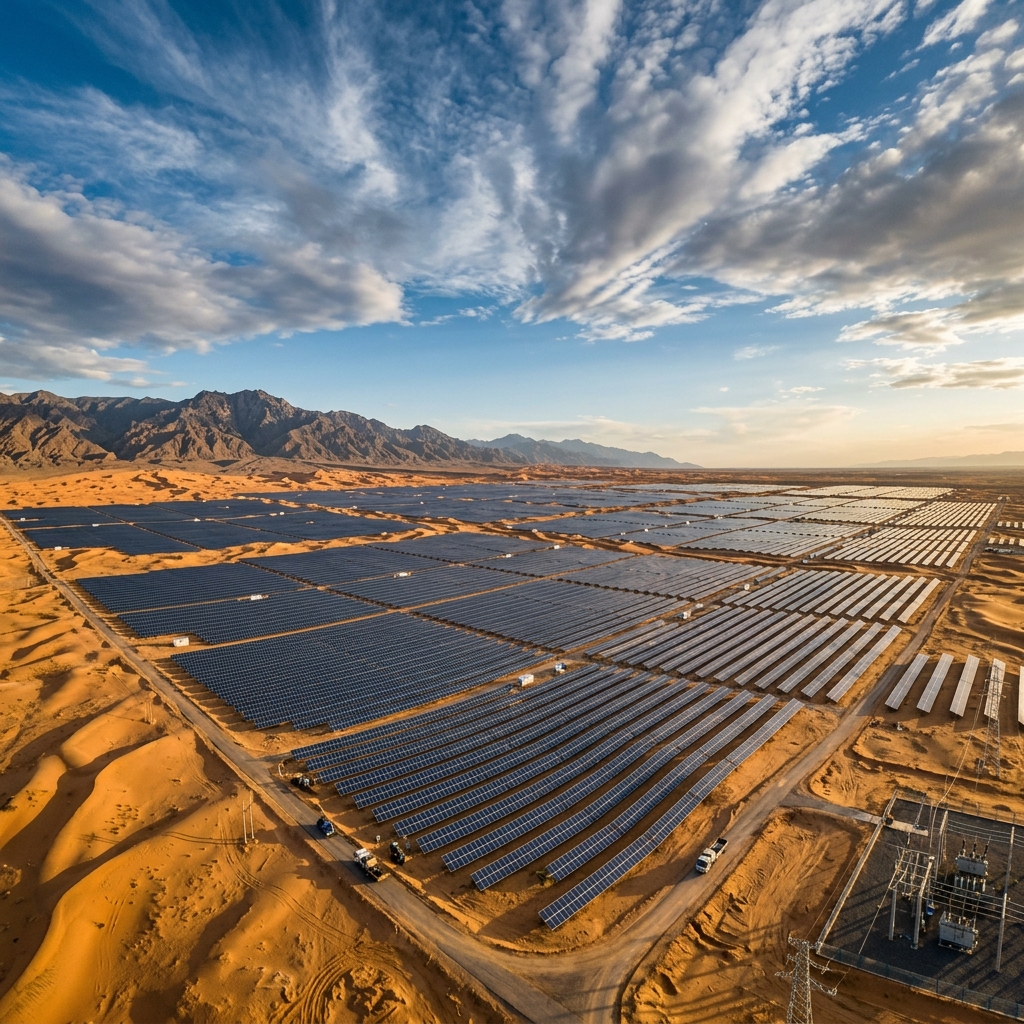
In the Talatan Desert of Qinghai Province, on the northeastern edge of the Tibetan Plateau, the land was 98.5 percent dead.
Not metaphorically dead. Measured dead. Satellite imagery confirmed it. The Chinese government classified it as severe desertification — sand, wind, and sun baking the earth into something closer to concrete than soil. Nothing grew. Nothing grazed. The nearest city, Gonghe, watched the desert creep closer every year.
Then they planted solar panels.
Not to fix the desert. To generate electricity. The Talatan Solar Park began as a straightforward energy project — panels in the desert because that’s where the sun is and nobody’s using the land. By the end of 2024, sixty-eight companies had installed over seven million panels across 609 square kilometers, generating 17.73 gigawatts of grid-connected capacity. The largest solar installation on earth.
What happened next was not in anyone’s business plan.
It Starts with the Shade
The panels cast shadows. That’s obvious — they’re physical objects between the sun and the ground. What wasn’t obvious was what shade does to desert soil.
Desert isn’t just hot. It’s dry because it’s hot. The sun hits bare ground, surface temperatures spike, and whatever moisture exists in the top few centimeters of soil evaporates before anything can use it. The cycle is self-reinforcing: no moisture means no plants, no plants means no root structure, no root structure means no water retention, no water retention means no moisture. The desert sustains itself through absence.
The panels broke the cycle at the first link. Shade dropped surface temperatures. Soil moisture evaporation fell by 30 percent. Wind speed through the arrays dropped by 50 percent — the rows of panels act as windbreaks, slowing the sand-carrying gusts that strip any biological progress from exposed ground.
Within months, maintenance crews noticed something: grass was growing under the panels.
The Uninvited Guest
Nobody planted the grass. Seeds were already in the soil — dormant, waiting for conditions that hadn’t existed in decades. The shade and moisture retention created by the panels crossed a threshold that the seeds recognized as survivable. They germinated.
This created a new problem. Grass growing into the electrical infrastructure is a fire hazard. The standard industrial response would be herbicide or mechanical mowing — both expensive at the scale of 609 square kilometers. Instead, someone had a different idea.
Bring in the sheep.
An agreement was reached with local herders. Technicians adjusted the panel layout, widening the spacing between arrays from three to five meters and raising the mounting height from fifty centimeters to between 1.5 and 1.8 meters. Enough room for sheep to walk, graze, and shelter under the panels during the hottest hours.
The sheep ate the grass. Their manure fertilized the soil. The fertilized soil grew more grass. The deeper root systems held more water. The panels kept providing shade. The cycle reversed — not into desert, but into something that hadn’t existed here in living memory.
Vegetation coverage went from 1.5 percent to 80 percent.
Read that again. From 1.5 percent to 80 percent. In a place that was functionally dead.
The Layers
A permaculture farmer would recognize what happened immediately. It’s the same principle that governs every food forest, every regenerative agriculture system, every intact ecosystem on the planet: life builds in layers, and the first layer is the canopy.
In a forest, the canopy is trees. Their shade creates the microclimate that supports the understory — shrubs, then ground cover, then soil organisms, then the mycorrhizal networks that connect everything underground. Remove the canopy and the layers collapse in sequence. The soil dies last, but it dies.
Desertification is deforestation’s endgame. It’s what happens when the canopy has been gone long enough that even the soil biology is gone.
The solar panels function as an artificial canopy. They’re not trees — they don’t transpire, they don’t drop leaves, they don’t participate in the water cycle the way a forest does. But they provide the one thing the desert needs to start the regeneration sequence: shade.
Shade → moisture retention → seed germination → grass → root structure → soil biology → nutrient cycling → more vegetation → more shade → feedback loop.
The panels didn’t heal the desert. They created the conditions for the desert to heal itself. The biology was waiting. It just needed permission.
The Numbers
The joint research team from the State Power Investment Corporation and Xi’an University of Technology documented the transformation with satellite remote sensing:
- Wind speed in the solar park: reduced 50 percent
- Soil moisture evaporation: reduced 30 percent
- Vegetation coverage: from 1.5 percent to over 80 percent
- Sheep grazing: 20,000+ animals across 32 eco-pastures and 56 grazing sites
- Villages supported: 18 villages participating directly in the grazing program; across the broader prefecture, 173 villages lifted from poverty through solar-related income
- Income per mu (0.16 acres): over 10,000 yuan ($1,400) — from land that generated zero
And one number that doesn’t appear in the official reports but that every solar engineer knows: panels run cooler over vegetation. The grass growing beneath the arrays reduces ambient temperature at the panel surface, improving generation efficiency by 5 to 10 percent. The desert healing itself makes the power plant work better.
The system pays for its own regeneration.
What This Has to Do with America
The United States has tens of millions of acres of degraded, contaminated, or underproductive land — roughly 20 million acres tracked by the EPA as contaminated sites, plus tens of millions more in BLM rangeland failing health standards and USDA-classified marginal cropland. Brownfields. Abandoned mines. Overgrazed rangeland. Former industrial sites. Superfund zones where nothing will be built for decades because of liability, but where solar panels — which don’t disturb the soil and don’t require the land to be safe for human habitation — could generate power while the ground beneath them begins to recover.
NREL’s InSPIRE project, the largest agrivoltaics research program in the world, has documented crop yield improvements under partial shade in arid climates. Colorado State University trials show certain crops produce more under panels than in full sun — the shade reduces heat stress and water loss. The same biology that activated in the Gobi is available in the American Southwest, the Great Plains, the Texas scrubland, the California Central Valley margins.
The US currently has over 62,000 acres in agrivoltaic production supporting more than 10 gigawatts. DOE and USDA project that utility-scale solar will require 4 to 11 million acres by 2050.
The question isn’t whether the land exists. The question is whether we see what the land can become.
The Counternarrative
Every week, another report says we’re heading off a cliff. Soil degradation. Water scarcity. Biodiversity collapse. Desertification spreading across every continent. The Sahel advancing south. The American West drying out. The aquifers depleting.
These reports are true. Every one of them is true.
And in the Talatan Desert, 98.5 percent dead land came back to 80 percent alive because someone put up solar panels and the sheep showed up.
This is not optimism. This is not “technology will save us.” This is a specific, documented, measured, satellite-verified case of dead land returning to life because an artificial canopy created the conditions for biology to do what biology does when you give it half a chance.
The cliff is real. And at the bottom of the cliff, something is growing.
The Unanswered Question
America has the land. America has the sun. America has millions of acres that aren’t doing anything except degrading further every year.
The Gobi experiment wasn’t a plan to heal the desert. It was a plan to generate electricity that accidentally healed the desert. The healing was free. It came with the shade.
If it works in the most hostile desert on the Tibetan Plateau, what does it do in Nevada? In West Texas? In the depleted farmland of the Dust Bowl states?
Nobody knows yet. Because we haven’t tried.
That’s not a tragedy. That’s an invitation.
Sources
- Xinhua News Agency, “Talatan Solar Park environmental monitoring data” (June 2024) — wind speed, soil moisture, vegetation coverage figures
- State Council Information Office of China (SCIO), “Talatan photovoltaic eco-pasture program” (October 2025) — 68 companies, 7.2M panels, 609 km², 20,000+ sheep, 32 eco-pastures
- People’s Daily, “Desert transformation through solar grazing” (October 2025) — panel spacing adjustments, village participation
- Scientific Reports (Nature), “Soil quality improvements under photovoltaic arrays” (2024) — Xi’an University of Technology research data
- NREL InSPIRE Program, “Innovative Solar Practices Integrated with Rural Economies” — US agrivoltaic data, 62,000+ acres, 10 GW
- DOE Solar Energy Technologies Office, “The Potential of Agrivoltaics” — projected land requirements through 2050
This is Meme #1 of the Solar Army content series: Infrastructure for the New American Century. Next: The Sun Never Sends a Bill — why the fuel cost of solar changes everything about energy economics.