
The Sun Never Sends a Bill
Part of: Infrastructure for the New American Century
The Sun Never Sends a Bill
Every coal plant is a machine for converting Appalachian mountaintops into electricity. Every gas turbine is a machine for converting fracked shale into electricity. Every nuclear reactor is a machine for converting enriched uranium into electricity. The machine has a fuel cost. The fuel has a supply chain. The supply chain has a price, and the price has an owner, and the owner has interests that are not yours.
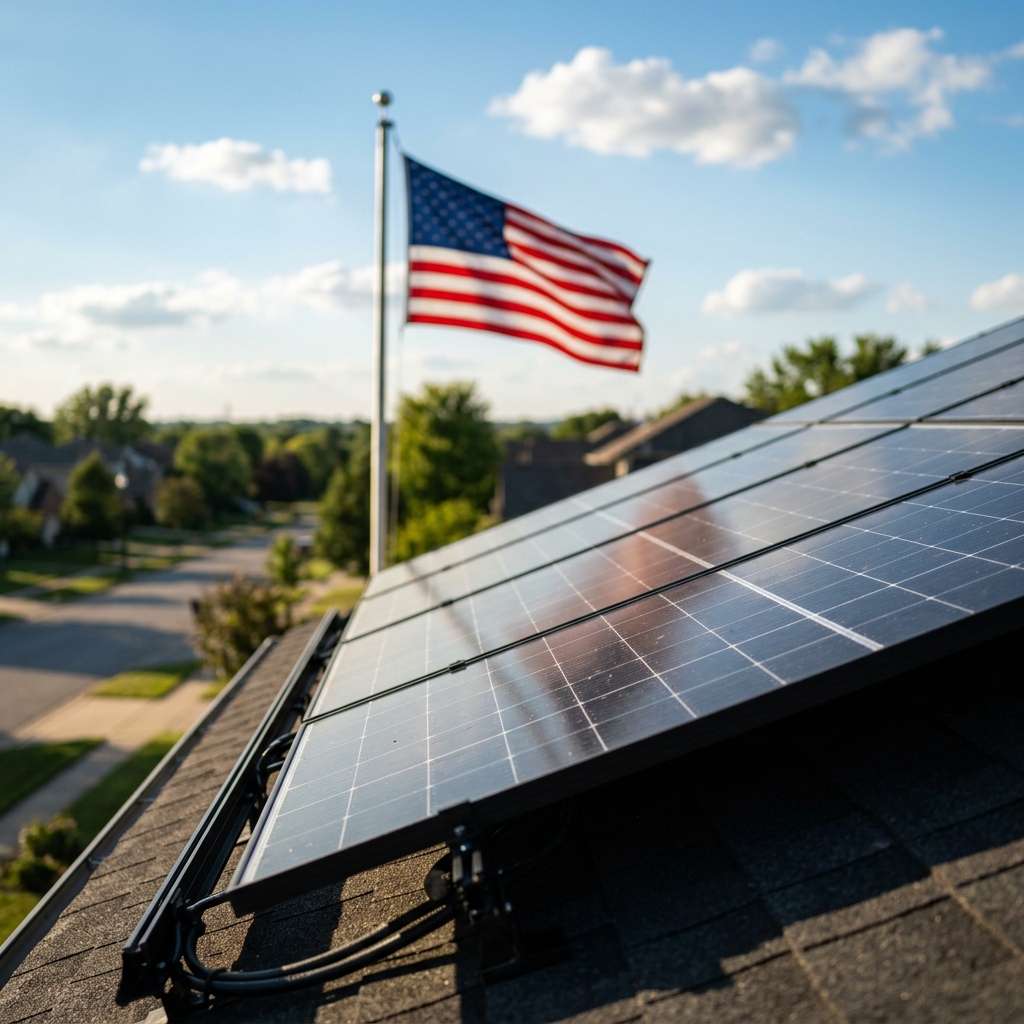
A solar panel is a machine for converting sunlight into electricity. The sunlight has no fuel cost. No supply chain. No price. No owner. No interests.
This is not a philosophical distinction. It is the most important economic fact in the American energy system, and it changes everything.
The Number
In 2025, Lazard — the Wall Street advisory firm, not an environmental group — released its annual Levelized Cost of Energy analysis. For the tenth consecutive year, solar and wind were the cheapest sources of new electricity generation in the United States. Not the cheapest clean energy. Not the cheapest renewable. The cheapest, period.
The numbers:
| Source | Cost per MWh (unsubsidized) |
|---|---|
| Utility-scale solar | $38 – $78 |
| Onshore wind | $37 – $86 |
| Gas combined cycle | $48 – $109 |
| Coal | $71 – $173 |
| Nuclear | $141 – $220 |
| Gas peaker | $149 – $251 |
Read the solar number again. The low end — $38 per megawatt-hour — is cheaper than gas at its cheapest. And solar’s cost dropped another 4 percent from the year before. It’s still falling.
These are unsubsidized numbers. No tax credits. No incentives. No government thumb on the scale. Just the cost of building the thing, running the thing, and paying for the thing over its lifetime. Solar wins on its own economics.
The sun never sends a bill. And that turns out to matter more than anything else.
The Learning Curve That Never Stopped
In 1977, a single watt of solar photovoltaic capacity cost $76.67. A typical American home needs about 8,000 watts. At 1977 prices, powering one house with solar would have cost $613,000 — just for the panels.
Today, that same watt costs between ten and fifty cents depending on where it’s made — Chinese commodity modules hit the floor, while American-made panels run higher. The panels for that house cost $800 to $4,000. The fully installed system — panels, inverter, racking, wiring, labor, permits — runs about $15,000 to $25,000 before incentives.
That’s a 99.87 percent cost reduction in less than fifty years.
This isn’t magic. It’s a manufacturing learning curve. In 1936, an aeronautical engineer named Theodore Wright noticed that every time aircraft production doubled, the cost per unit dropped by a fixed percentage. The principle holds across almost every manufactured technology: the more you make, the cheaper each one gets. Not because the materials get cheaper, but because the process gets smarter — fewer defects, less waste, better tooling, more automation, deeper expertise.
For solar, the learning rate is about 23 percent: every time cumulative global production doubles, the price per watt drops by roughly a quarter. This relationship has held since 1976. It held through the oil crises. It held through the 2008 recession. It held through the 2022 polysilicon shortage. It held through trade wars, tariffs, and pandemics.
The industry has a name for it: Swanson’s Law, after Richard Swanson, founder of SunPower. At current rates, solar costs drop about 75 percent every decade.
There is no equivalent law for coal. There is no equivalent law for gas. There is no equivalent law for nuclear. Fossil fuel costs fluctuate with commodity markets, geopolitics, and extraction difficulty. Solar costs follow a one-way ratchet driven by cumulative human learning. The more panels the species builds, the cheaper each one gets. Forever.
Made in America — For Real This Time
For years, “solar” meant “Chinese.” And for years, that was basically true. Chinese manufacturers dominated global panel production with massive state subsidies and vertically integrated supply chains that no American company could match on price.
That’s changing. Fast.
As of early 2025, the United States has over 50 gigawatts of domestic solar module manufacturing capacity — up from 8 gigawatts before the Inflation Reduction Act passed in 2022. That’s more than a 700 percent increase in three years.
The names:
First Solar — 14 gigawatts of annual domestic capacity across factories in Ohio, Alabama, and Louisiana. American-founded, American-headquartered, American-built. Their cadmium telluride thin-film technology was invented in the US and is manufactured entirely on US soil. No Chinese supply chain dependency.
Qcells — 8.4 gigawatts in Dalton, Georgia, with a new facility in Cartersville aiming for full supply chain integration — ingots, wafers, cells, and modules all made in Georgia. When Cartersville is fully operational in late 2026, Qcells will manufacture every component of a solar panel on American soil. That hasn’t been possible at scale in over a decade.
And they’re not alone. Meyer Burger, Canadian Solar, Silfab, Heliene, Mission Solar, and others are building or expanding US facilities. The wave of Made-in-USA solar products arriving in 2025–2026 is the largest domestic manufacturing buildout in the industry’s history.
This matters for three reasons beyond economics:
Security. Domestic panels don’t have hidden cellular radios installed by a foreign government. (More on that in a future piece.)
Jobs. Every factory is hundreds of manufacturing jobs in communities that need them. First Solar alone employs over 3,000 people across its US manufacturing operations, with nearly 5,000 projected by 2027.
Resilience. A domestic supply chain can’t be disrupted by a trade war, a shipping lane closure, or a policy decision made in Beijing. When the panels are made here, the power stays here.
Your Roof Is a Power Plant
Let’s bring this down from utility-scale to your house.
The average American residential solar system in 2026 is a 7-to-8 kilowatt array. It costs between $18,000 and $25,000 before incentives. It generates electricity for 25 to 30 years, with most panels warranted to produce at least 80 percent of their original output at year 25. Many last 35 years or more.
The math is simple. A typical system saves $30,000 to over $100,000 over its lifetime, depending on local electricity rates and sun exposure. In most of the country, the system pays for itself in 7 to 12 years, then generates free electricity for the remaining 13 to 18 years.
Free is the wrong word. The electricity isn’t free — you paid for it upfront when you bought the system. But after payback, your marginal cost per kilowatt-hour is zero. Your utility can raise rates every year. Your panels don’t care. The sun doesn’t renegotiate.
This is what “the sun never sends a bill” means in practice. It’s not a slogan. It’s an accounting statement. After payback, you have a power plant on your roof with no fuel cost, no variable cost, and no price exposure to commodity markets, foreign policy decisions, or corporate earnings targets.
The market has matured. Prices stabilized in 2023-2024 after a decade of consistent declines. Equipment costs hit bottom due to global oversupply. Installation labor costs are steady. The era of dramatic annual price drops is over — not because something went wrong, but because solar reached the flat part of the cost curve where it’s simply cheap. Mature technology. Competitive market. The revolution already happened.
The price of a panel is now a rounding error in the cost of a system. What you’re paying for is labor, permitting, and the inverter. The photovoltaic miracle — turning photons into electrons on a silicon wafer — costs almost nothing. The hard part is the paperwork.
The Derivative Question
Every dollar you spend on electricity from a fossil fuel plant travels a supply chain. Some of it goes to the gas company. Some goes to the pipeline operator. Some goes to the royalty holder. Some goes overseas to the nation-state that controls the gas field. At every link in the chain, someone takes a cut, and at the end of the chain, the dollar is gone — extracted from your community, never to return.
Every dollar you spend on a solar panel travels a different chain. Some goes to the manufacturer (increasingly domestic). Some goes to the installer (always local). Some goes to the permit office (always local). And then the chain stops. There is no fuel to buy. There is no ongoing extraction. The dollar you spent stays closer to where you spent it, and the electricity it bought has no further cost.
This is the macroeconomic argument that almost nobody makes: solar is an import substitution technology at the household level. Every kilowatt-hour you generate on your roof is a kilowatt-hour you didn’t buy from a system that sends money out of your community, out of your state, out of your country. Multiply that by 100 million rooftops and you’re talking about the largest wealth retention program in American history — not through policy, but through physics.
The derivative economy — the financial system built on top of commodity flows — doesn’t disappear. It redirects. Capital that used to flow toward oil futures and gas pipeline bonds can flow toward solar manufacturing, battery storage, and grid modernization. The financial instruments exist. The yields are competitive. The risk profile is better — solar projects have 25-year revenue visibility with no fuel price exposure. What portfolio manager wouldn’t prefer that?
The shift is already happening. Private equity firms are acquiring clean energy assets. Infrastructure funds are overweight solar. The smart money moved years ago. The thesis Bill Clinton pitched to oil companies in 2000 — “see yourselves as energy companies, not oil companies” — finally has the economics to back it up. Solar at $38/MWh and falling. The thesis was right. The timing was wrong. Now both are right.
The Fuel Cost Trap
Here’s the thing about fuel costs that most people never think about: they’re not just a line item. They’re a dependency.
If your electricity comes from a gas plant, you need gas. To get gas, you need wells, pipelines, processing facilities, and a global commodity market that sets the price. You are dependent on all of those things working, all of the time, at a price you can afford. If any link breaks — a pipeline explosion, a trade embargo, a hurricane in the Gulf, a war in the Middle East — your electricity price spikes and there’s nothing you can do about it.
If your electricity comes from a solar panel, you need the sun. The sun is not subject to trade embargoes. The sun does not have a commodity market. The sun does not spike in price when a tanker gets blockaded in the Strait of Hormuz.
Every energy source with a fuel cost is a dependency chain that extends outside your control. Solar has no fuel cost. That’s not just cheaper. It’s freer. It’s a declaration of energy independence — not at the national level (though it’s that too), but at the household level, the community level, the county level.
Every rooftop installation is a tiny act of sovereignty. You may not think of it that way when you’re signing the contract. But the grid notices. The utility notices. The commodity trader notices. And the foreign government that used to collect a fraction of a cent every time you turned on a light — they notice too.
What Comes Next
The Desert Blooms showed what happens when you put solar panels on dead land — the land comes back to life. This piece showed what happens when you look at the economics — the numbers are overwhelming and they only go in one direction.
But cheap electricity that grows grass isn’t enough to rebuild a civilization. You need to store it. You need to move it. You need to protect it.
The next piece in this series is about salt — the most abundant mineral on earth, the ancient currency of empires, and the chemistry that’s about to change everything about how we store the sun.
Sources
- Lazard, “Levelized Cost of Energy+ Version 18.0” (June 2025) — LCOE table data, tenth consecutive year finding
- Our World in Data, “Solar PV Module Prices” — historical cost data from $76.67/watt (1977) through present
- Wikipedia, “Swanson’s Law” — 23% learning rate, 75% per decade cost reduction, Richard Swanson / SunPower attribution
- ARK Invest, “Wright’s Law” — Theodore Wright’s 1936 learning curve discovery
- SEIA / Wood Mackenzie, “U.S. Solar Manufacturing Capacity Report” — 51 GW domestic capacity, up from ~8 GW pre-IRA
- First Solar, “Manufacturing Overview” — 14 GW US capacity across Ohio, Alabama, Louisiana; 3,000+ US employees
- Hanwha Qcells, “Cartersville Factory Announcement” — 8.4 GW combined Georgia capacity
- EnergySage, “Solar Panel Cost Guide 2026” — residential system sizing, pricing, payback periods
- EnergySage, “Understanding Your Solar Panel Payback Period” — 7–12 year payback range, lifetime savings estimates
This is Meme #2 of the Solar Army content series: Infrastructure for the New American Century. Previous: The Desert Blooms — how solar panels turned the Gobi Desert from 98.5% dead to 80% alive. Next: The Salt of the Earth — sodium-ion batteries and the end of lithium dependency.